Process for Probating a Will with a Dependent Executor

This is a brief outline of the process for probating the Will of a Decedent when the will does not specify an independent executor.  The outline is not exhaustive, but it gives a general overview.

1.         Attorney files an Application Probate of Will Produced in Court and for Letters Testamentary with the probate court.[i]

The application must be accompanied by:

  • Filing fee.
  • Original Death Certificate.
  • Original Will.

2.         Wait 10-15 days while Citation to Interested Parties is posted by the clerk.[ii]

3.         Set a hearing in probate court.

4.         The Applicant and Applicant’s Attorney attend the hearing in probate court.[iii]

  • Generally takes less than a half hour.
  • Applicant testifies to death of Decedent, authenticity of Will, and other facts.
  • Judge signs Order appointing Applicant to be Executor.
  • Executor signs Oath.
  • Clerk issues Letters Testamentary.

5.         Executor administers the estate.[iv]

  • Gathers all assets.
  • Pays bills.
  • Distributes remaining assets to beneficiaries.

6.         Attorney provides notices required by law.

  • Publishes Notice to Claimants in local newspaper within 30 days.[v]
  • Sends Notice to Secured Creditors within 60 days.[vi]
  • Sends Notice to Beneficiaries within 60 days.[vii]
  • Files Proof or Certificates of Notice with probate court.

7.         Attorney files Estate Inventory with the probate court within 90 days.[viii]

  • Executor must furnish Attorney with information for drafting the Inventory.
  • Court signs order approving inventory.

8.         Executor must obtain court approval to sell property, pay bills, and take any other actions.

9.         Executor completes the administration of the estate, and Attorney finishes by filing Final Account.[ix]

  • Administrator provides to Attorney a list of assets collected, debts paid, debts not paid (should be none), assets remaining (should be none), distributees who received assets.
  • Attaches receipts.
  • Attorney drafts the Final Account and Files with court.
  • Attorney serves citation on beneficiaries.
  • Court examines and approves the Final Account.

.

The probate process is complete.  There may be more work to do to administer the estate.


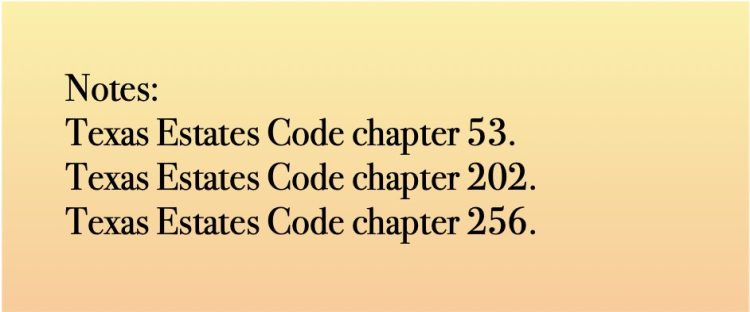
Notes on Texas Estates Code chapters related to probate process.

Determination of heirship without administration

Here is a brief outline of the process for determining the heirs of a Decedent, if there is no Will.

1.         Attorney files an Application for Determination of Heirship naming all heirs with the probate court.

The application must be accompanied by:

  • Filing fee; and
  • Original death certificate.

2.         Interested parties must receive notice.

  • Clerk posts Notice of Citation on the courthouse bulletin board.
  • Attorney publishes Notice of Citation in the newspaper.
  • Attorney sends written notice to all heirs and devisees.
  • Attorney files Proof of Citation and Proof of Notice with court.

3.         Attorney asks all heirs to sign an agreement waiving citation and allowing independent administration.

  • Attorney files signed agreements with court.
  • Heirs who the sign agreements will not need to receive citation.
  • Heirs who fail to sign the agreement will need to receive citation issued by the clerk.

4.         The probate court will appoint an Attorney ad Litem to investigate the facts.

  • Applicant must provide names of two disinterested witnesses who can testify in court to the family history.
  • The ad Litem will interview the witnesses by phone.
  • The ad Litem will file a report with the probate court.
  • After the Attorney ad Litem files the report, Attorney sets a hearing in probate court.

5.         The Attorney will prepare documents to be presented at the hearing.

  • Proof of Death and Other Facts to be signed by Applicant.
  • Testimony Concerning Identity of Heirs to be signed by each witness.
  • Order Determining Heirs to be signed by the Court.

6.         The Applicant, the Applicant’s Attorney, and the two disinterested witnesses attend the hearing in probate court.

  • The Attorney ad Litem also attends.
  • Generally takes less than a half hour.
  • Applicant testifies to death of Decedent and other facts.
  • Disinterested witnesses testify to family history.
  • Judge signs Order Determining Heirs.
  • Administrator and witnesses sign their testimony.

7.         An heir named in the judgment may collect money owed to him through the Decedent.


Establishing heirs of an estate on an affidavit

Here is a brief outline of the process for establishing the heirs of a Decedent, by filing a small estate affidavit.

No administration necessary

1.         Where the decedent died intestate, no administration is necessary if the value of the estate assets is less than $75,000.

  • This maximum value does not include homestead and exempt property.

Determining heirs

2.         Attorney files with the probate court a Small Estate Affidavit that:

  • Lists all known estate assets and liabilities;
  • names all heirs and gives their addresses;
  • gives relevant family history showing heirship and shares of taking.

3.         The affidavit must be signed by:

  • Two disinterested witnesses; and
  • All of the distributees.

4.         The court may hold a hearing on the Affidavit.

5.         The judge approves the Affidavit.

Collecting the small estate

6.         Obtain certified copies of the Affidavit from the clerk.

  • Present a certified copy of the Affidavit to any person owing money to the estate.

Probating a Will as Muniment of Title

Here is a brief outline of the process for probating the Will of Decedent as a muniment of title. 

1.         Attorney files an application for probate of will with the probate court.

The application must be accompanied by:

  • Filing fee;
  • Original death certificate; and
  • Original Will.

2.         Wait 10-15 days while the notice of the application is posted by the clerk.

3.         Set a hearing in probate court.

4.         The Applicant and Applicant’s Attorney attend the hearing in probate court.

  • Generally takes less than a half hour.
  • Applicant testifies to death of Decedent, authenticity of Will, and other facts.
  • Judge signs Order admitting will as muniment of title.

5.         File Order and copy of will in property records, if any real property.

6.         Beneficiaries settle estate among themselves.

  • Distribute assets to beneficiaries designated in Will.
  • Gather remaining assets & divide them among beneficiaries or heirs.

7.         Attorney files affidavit of completion with the probate court within 180 days

The probate process is complete.  There may be more work to do to administer the estate.

Passing title by affidavit of heirship

CraveyLaw Memo by Robin T. Cravey

Sometimes, when a family member dies, there doesn’t seem to be any urgent need to settle their estate through the probate courts.  The family may go on as usual until years have passed.  If more than four years pass, then the courts cannot establish an administration on the estate, and passing title to property becomes more difficult.  In other families, the only property that needs to be passed is a piece of real property.

In situations like this, an Affidavit of Heirship can be useful.  The affidavit is a sworn statement, and it establishes the heirs of a Decedent.  It is then filed in the official county records.  This is an extra-judicial process, meaning that nothing is filed in probate court.

No administration established

1.         Where the decedent died intestate, and more than four years have elapsed, no administration can be established, even through the probate court.

2.         If the property to be transferred is simple enough, no administration is needed.

Determining heirs & other facts

3.         An attorney should draft the Affidavit of Heirship.  It will trace the decedent’s family tree and name all the heirs.  It will also list any debts or taxes owed, as well as any real property owned by the decedent.

4.         The affidavit should be signed (before a notary public) by all of the heirs and two disinterested witnesses.  The disinterested witnesses must be people familiar with the decedent’s family history, but they cannot be heirs.

Transferring title to real property

5.         The Attorney files the Affidavit of Heirship in the county property records.  After the affidavit has been on file for five years, it can be admissible in court to prove heirship.

6.         When the heirs are selling real property, a title company insuring the sale may accept the Affidavit of Heirship the same day it is signed. 

Texas Estates Code & Texas Rules of Evidence
Notes

Passing title by affidavit of heirship

Paying claims against the estate

Paying claims against the estate is a basic duty of the executor or administrator.  These claims include the debts of the decedent as well as expenses of administration.  Texas law sets out rules and priorities for how the claims should be paid. (See Texas Estates Code chapter 355.)

General rules for claims

1.         Don’t pay any claim that is barred by the statute of limitations.

2.         Claims should be classified and paid in the following order:

  • Class 1:  Funeral expenses and expenses of last illness up to $15,000.
  • Unclassified:  Allowances to surviving spouse & children.
  • Class 2:  Expenses of administration and management of estate.
  • Class 3:  Secured claims, e.g. tax liens.
  • Class 4:  Delinquent child support & arrearages.
  • Class 5:  Taxes, penalties, and interest.
  • Class 6:  Costs of confinement in Texas prisons.
  • Class 7:  Repayment of Medicaid assistance.
  • Class 8:  All other claims.
    • (includes funeral expenses & expenses of last illness over $15,000)

3.         Do not pay a claim in class 8 before all claims above it have been paid.

4.         If you have money on hand to pay only some of the claims in a class, pay a pro rata share of all claims in that class.  Do not pay one claim in the class while holding another claim in the same class to wait for additional funds to come in.

5.         If the claims against the estate exceed the assets, then pay the highest claims first, and divide the remainder pro rata among the last class of claims to be paid. 

6.         Do not distribute to beneficiaries or heirs until all claims have been paid.

Claims filed in court

If a creditor of the deceased has filed a claim in the probate court, it is important to show that the claim was handled properly.

1.         Determine if the claim is valid and within the statute of limitations.

2.         Determine if there will be sufficient assets to pay all claims in the same class (and all claims classed above it).

3.         If the claim is valid, and the estate has the funds to pay it, notify the creditor that the claim will be allowed.

4.         In the letter allowing the claim, set out the terms of payment:

  • Obtain the name & title of the person authorized to sign a Certificate of Satisfaction of claim.
  • Provide that within 20 days after the payment is received, the signer will sign and send a satisfaction of claim.
  • Require the authorized person to sign and return the notice letter showing agreement to the terms.

5.         Send the check, with a note in the memo line.

6.         When the creditor sends the Certificate of Satisfaction of claim, your lawyer will file it with the court.


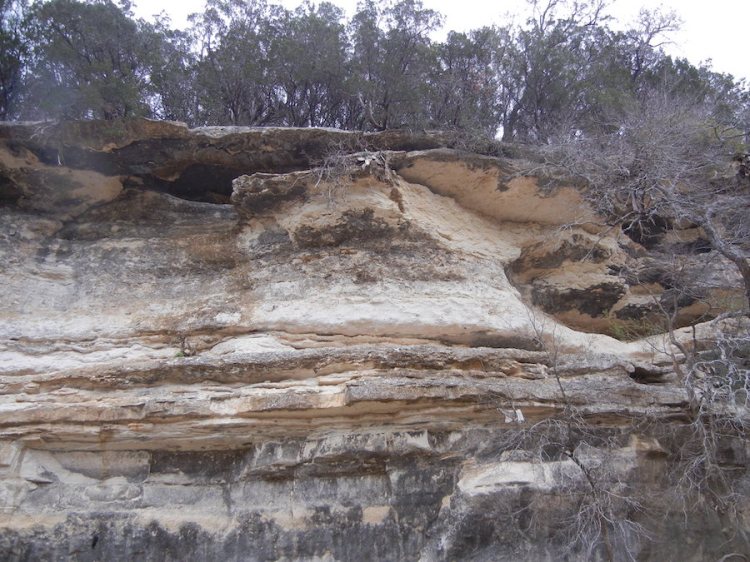
Limestone cliff above Barton Creek
Limestone cliff above Barton Creek shows the precariously thin rock at the edge.

Paying claims against the estate

Community Property

Texas is one of a handful of states that recognizes community property in marriage.  Property owned by married persons is either community property or separate property.

A.      Definitions

1.         Separate Property consists of:  Property owned by a spouse before the marriage;  Property acquired by one spouse during the marriage by gift, devise, or descent; and. Proceeds recovered in a lawsuit for personal injuries sustained by one spouse.

2.         Community Property consists of:  Everything acquired during marriage that is not separate property.  For example, a spouse’s earnings are community property.

B.      Tracing separate and community

3.         Community property belongs jointly to husband and wife; each spouse controls only his or her undivided one half.  Separate property, on the other hand, belongs exclusively to one spouse.  One spouse’s creditors generally cannot reach the other spouse’s separate property, but they may be able to reach community property.

The name on the deed or certificate of title does not matter.  What matters is whether the property was acquired during marriage.

4.         At the dissolution of a marriage (death or divorce), all property on hand is presumed to be community property, absent clear and convincing evidence to the contrary.  If separate property has been “commingled” with community property, the community acquires a claim on the separate property.

5.         To keep separate property separate, you must segregate it from community property and keep clear records of its ownership.  In some situations, recording a schedule of a spouse’s separate property in the county’s deed records is appropriate.

For example, when a spouse makes mortgage payments on a separate property house from his earnings, then the community “estate” owns a claim against the separate “estate.”

6.         Rents, revenue, and income earned from separate property are community property.  However, the proceeds from the sale of separate property are separate property, provided they are tracked and not commingled.

7.         A couple may use a Marital Property Agreement to convert community property to separate property or vice versa.  Separate property created under such an agreement has the same characteristics as other separate property, so income derived from this property would be community property (and the proceeds from the sale of this property would be separate property) unless the agreement states otherwise.

See Texas Family Code § 3.001 et seq.

Community Property

The Estate Executor’s Powers & Duties

Aside from all the work of probating an estate, there is the work of administration.  This must be done according to Texas law, and according the decedent’s Will, if there was one.

In an Independent Administration, once the court has approved the estate inventory, there is no further action to be done in probate.  The executor generally can carry out her duties without any further orders from the court.

The powers and duties are broad and deep, and begin as soon as Letters Testamentary have been issued.  The executor is required to use prudence and ordinary diligence in administering the estate.  This is a brief checklist of the executor’s powers and duties.

1.            Handle estate funds separately from personal funds.  At the outset, obtain a federal tax number (EIN) for the estate.  With the tax number, open an estate bank account.  All estate transactions must go through this account.

2.       Take care of the property of the estate.  Keep any buildings in repair and insured.  Sell real estate or personal property belonging to the estate when necessary.  Sign deeds and other documents as executor and not individually.  Take possession of all personal property and records.

3.        Collect all claims and recover all property owned by the estate.  For example, if someone owed money to the Decedent, the Executor collets it.  This includes pursuing or defending against lawsuits on behalf of the estate.

4.         Provide to the Attorney an Inventory of all estate assets and all claims due to the estate and have the Attorney file it with the Court.

5.            Pay expenses of last illness, expenses of burial, and expenses of administration first.  The Executor may receive reasonable compensation for services rendered to the estate.  The Executor may hire lawyers, accountants, and other professionals as needed.

6.      Pay all claims against the estate properly.  File tax returns of the Decedent and of the estate.  If there is any chance that the estate will not have enough funds to pay all debts of decedent, then pay them in the order set out by state law.

7.         Keep records of all transactions on behalf of the estate with receipts, and render an accounting if demanded by any of the beneficiaries.

8.         Maintain a cash reserve until all debts, claims, and expenses have been paid before making final distribution to the beneficiaries.

9.            Distribute the net estate to the beneficiaries according to the instructions in the Will.

The Estate Executor’s Powers & Duties

Real Estate sales documents

Generally, a real estate sale begins with a contract and ends with a deed.  The deed fulfills the contract, and the contract is merged into the deed.

A Real Estate Sales Contract

1.         Is negotiated between the parties.

A buyer and seller negotiate about the purchase and sale of a piece of property.  They negotiate about what conditions will permit the buyer or seller to terminate the contract and cancel the purchase and sale, how much the buyer will pay, when the buyer will pay, what rights in the property the seller will sell, what obligations the buyer or seller will have after the purchase and sale. 

2.         Sets the terms of the sale.

Once the buyer and seller agree on all the terms of the sale, they sign a contract that spells out all the details of their agreement.

The contract serves three primary purposes.  It sets the date of closing, lists the actions the buyer and seller must or may take before closing (the inspection period), and describes the terms that must be in the deed.

3.         Ceases to have any force after the deed is signed.

When the deed is signed, the contract is said to be merged into it.  It is assumed that all the actions that were supposed to be taken before closing were taken or were waived.  And it is assumed that all the important terms in the contract were translated into the deed or were waived.

4.         Common Additional documents are
Seller’s disclosure of property condition.
Seller’s disclosure of lead-based paint. (home built before 1978)
Title commitment.
Survey
Settlement statement

A General Warranty Deed

1.         Is drafted according to the contract.

If the contract calls for a straightforward sale, then the deed will be pretty short, though it does contain some ‘magic words.’  If the sale is more complicated, the deed will be longer.  The most common complication is an installment sale, in which case the deed will contain a lien allowing the seller to take the property back if the buyer doesn’t make all the payments.

2.         Is signed at closing.

The closing is a meeting at which the buyer gives payment and the seller signs the deed.  Any other documents that must be signed for the sale will also be signed at the closing.  In a very real sense, this closes the sale.  The buyer walks out an owner, and the seller walks out a former owner.

3.         Transfers title to the property.

The signed deed is filed in the real property records at the county clerk’s office.  That gives notice to the world of who owns the property.  That is the document that a court will examine if there is ever a dispute about who owns the property.

4.         Lists any other agreements pertaining to the property.

Any other agreements that affect the property must be listed in the deed, or they will not affect title to the property.  If the buyer has promised to pay for the property over a period of time, the promissory note will be listed in the deed.

A Deed of Trust & Real Estate Lien Note

1.         Deed of trust sets out procedure for non-judicial foreclosure if buyer defaults.

2.         Real estate lien note sets the terms of the installment loan that the buyer is using to finance the purchase.  It can be between the buyer and the seller or between the buyer and a third party.

© 2022 by Robin T. Cravey

Real Estate sales documents

Process for probating a Will

This is a brief outline of the process for probating the Will of a Decedent.  The outline is not exhaustive, but it gives a general overview.

1.         The Attorney files an Application Probate of Will Produced in Court and for Letters Testamentary with the probate court.  The application must be accompanied by:  Filing fee;  Original Death Certificate; and  Original Will.

2.         Wait 10-15 days while Citation to Interested Parties is posted by the clerk.

3.         Set a hearing in Probate Court.

4.         The Applicant and Applicant’s Attorney attend the hearing in Probate Court.  Generally takes less than a half hour.  Applicant testifies to the death of Decedent, authenticity of the Will, and other facts.  Judge signs the Order appointing Applicant to be Executor.  Executor signs the Oath.  The Clerk issues Letters Testamentary.

5.         Executor administers the estate.  Gathers all assets.  Pays bills.  Distributes remaining assets to the beneficiaries.

6.         Attorney provides notices required by law.  Publishes Notice to Claimants in local newspaper within 30 days.  Sends Notice to Secured Creditors within 60 days.  Sends Notice to Beneficiaries within 60 days.  Files Proof or Certificates of Notice with probate court.

7.         Attorney files Estate Inventory with the Probate Court within 90 days. Executor must furnish Attorney with information for drafting the Inventory.  Court signs Order approving inventory.  Probate Court does not require anything more.

8.         Executor may have Attorney file a Closing Report or Notice of Closing.  This is optional.  It’s not required.  This ends the Executor’s responsibility and authority.

The probate process is complete.  There may be more work to do to administer the estate.
Sources:
Texas Estates Code § 256.051-256.053.
Texas Estates Code § 258.001
Texas Estates Code §§ 256.151, 256.152, 256.201, 305.051, 306.003, 306.004
Texas Estates Code §§ 402.002, 351.101, 351.102, 351.151—351.153, 351.051-351.054, 355.101-355.108.
Texas Estates Code §§ 308.051-308.052
Texas Estates Code § 308.053.
Texas Estates Code §§ 308.002-308.004.
Texas Estates Code §§ 309.051-309.054.
© 2022 by Robin T. Cravey

Process for probating a Will